
01Services
Full-Service MLS®
HDR photos, drone, video, print — all in.
Buyer's Agency
Sharp data, clear negotiation.
Rental Management
Leasing, screening, tenant care.
Advisory
Investment strategy backed by data.
Victoria, Unlisted
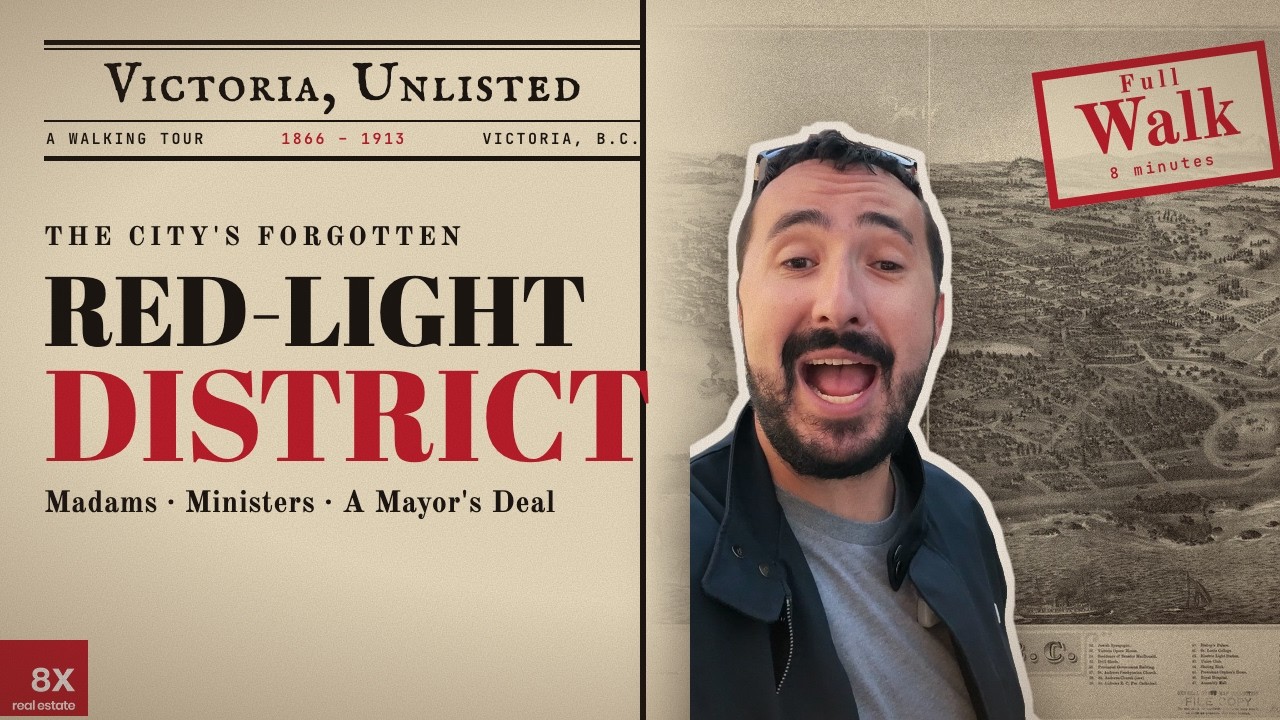
In 1866, a local paper called Victoria "the most licentious spot on the entire Pacific coast, from Sitka to Valparaiso." In plain English, the wildest town on the coast. I walked the city's old red-light district to find out who owned the buildings, who ran them, and how it ended. It turns out a lot of it was a property story, and two of its lessons still apply if you're buying a home here today.
Victoria BC Red-Light District: Madams, Ministers & a Mayor's Deal (8 min). The full walk from the Victoria, Unlisted series.
About 130 years ago, the corner of Douglas and Broughton was the high end of Victoria's red-light district. Victoria was a port full of single men, and by 1900 the police chief counted nearly 300 known sex workers in the city.
On the southeast corner, an American named Alice Seymour ran one of the best-known brothels in the Pacific Northwest. It was a parlour house, the top of the trade, with parlours, music and wealthy clients. The best houses here served men from the nearby Union Club, and they were never raided. Historians think the clients may explain that. Right across the street, St. Andrew's Presbyterian Church had brothels for neighbours on Broughton.
When the police did raid, it was mostly for show. In 1892, a madam on Broughton named Maud Lord pleaded guilty, paid a $50 fine and got one hour in jail. The fine worked like an unofficial business licence: pay it and carry on.
The brick Duck Block on Broad Street went up in 1892, and its façade is still there today. It was built by Simeon Duck, a former provincial finance minister, and for years it housed brothels. There was even a music hall inside, the Lyceum, where women looked for clients among the crowd.
In 1899, a young American named Stella Carroll bought a brothel business upstairs in the Duck Block. Duck was her landlord. He was well connected, and with his protection the police mostly left her alone. She ran it like a boarding house: the women paid her rent, and Stella made her money selling liquor.
Duck wasn't unusual. In 1886, the police chief made a list of the city's "houses of ill fame" and wrote down who owned each one. The owners included a city alderman, a cabinet minister, and a former mayor who was also a former police officer. Behind the scandal, it was a property business, and respectable people were collecting the rent.
Then in 1905, Simeon Duck died, and Stella's protection died with him.
Around 1900, Chatham Street at Store was lined with cribs. A crib was a one-room shack where a woman lived and worked. In 1903, at least 50 women worked in cribs on Chatham between Store and Government.
On July 23, 1907, a fire tore through this part of the city. The Colonist reported women running into the street in whatever they had on, asking for help. No one was killed. The cribs were gone, and today the Capital Iron parking lot marks the spot where they stood.
In 1906, Victoria elected a reform mayor, Alfred Morley. He and the police chief sat down with Stella and made her a deal: move your business out of downtown to Herald Street, and the police will leave you alone.
So she moved to Herald Street. Historians list the building as 679 Herald. It's still standing, and it was already there when she arrived; BC Assessment dates it to 1901. But church groups and a local paper kept pushing, and the police raided her anyway. After the 1907 fire, the City confined brothels to a small stretch of Chatham and Herald, west of Douglas.
The lesson that still holds
A handshake deal with City Hall, or with your neighbour, isn't a permit or a registered easement.
If a seller tells you the City is fine with that suite, ask to see the permit. If it isn't in writing, it can change.
Stella grew up in a sod house in Missouri, a house built from blocks of earth. She became one of the best-known madams on the West Coast, from San Francisco to Victoria. Her love life was rough: one lover shot her in the leg, and it had to be amputated. She kept working anyway. And her best property wasn't downtown at all.
In 1908, Stella bought a mansion on a hill above the Gorge, off Gorge Road. It was called Rockwood, and it was designed by John Teague, the architect of Victoria's City Hall. Its tower could be seen from across the water. Steps ran down through the garden to a private dock, so a client could arrive by boat and no one would see him come in. By land it was easy too: a good road for carriages, a tram out to Gorge Park, and canoes to rent for a paddle up the channel.
And Rockwood was in Saanich, out of reach of the Victoria police. Her biographer, Linda Eversole, put it this way:
As with most real estate, its value was in the location.
What that location gave her was easy, discreet access. Her neighbours didn't agree. They included the Premier of BC, Richard McBride, and they did not want her there. Then her own lawyer, Aikman, took the job of Saanich prosecutor. He knew all her business secrets, and Saanich wasn't safe anymore. Stella left Victoria in 1913. Rockwood burned down in 1923, and its exact site is still not confirmed.
If you're buying
In Greater Victoria, your mailing address doesn't tell you the rules. Lots of homes with a Victoria address are actually in Saanich, Esquimalt or Oak Bay, and each has its own zoning bylaw and development permit areas.
If you're buying for a suite, a rental or a home-based business, check which municipality the home is really in, then read that zoning. The address says Victoria. The rules might say Saanich.
These were real women, and most of their names are lost. A few are not.
Edna Farnsworth died in 1889 in a brothel on Broughton Street. Her headstone says she was 20. She was first buried in an unmarked grave in the plot for strangers. Later, someone paid for one of the finest stones in the cemetery at the time. Nobody knows who. In 2025, the Old Cemeteries Society restored it.
A few steps away is Henrietta Morgan. She came up from San Francisco and ran a brothel in Victoria. Her name is on the police chief's 1886 list, and her stone says she died that summer, at 38.
Victoria's red-light district faded out before the First World War, pushed by reformers and by money. A few of the buildings still stand. If you want the whole story, read Linda Eversole's Victoria Unbuttoned (2021) and her biography Stella: Unrepentant Madam (2005).
Want the story of the ground under your own home?
Talk to Dustin Miller, Managing Broker at 8X Real Estate. Title, zoning and permits checked before you write the offer, not after.
Buy with 8X Sell with 8X Victoria market data, updated daily →Sources: Linda J. Eversole, Stella: Unrepentant Madam (2005) and Victoria Unbuttoned (2021) · Patrick Dunae, Clio Media · Daily Colonist (1892, 1907, 1908) via UVic Libraries / Internet Archive · Old Cemeteries Society of Victoria · The Canadian Encyclopedia, "John Teague" · CHEK News · Times Colonist. General information, not legal advice.

Dustin Miller is the managing broker of 8X Real Estate. When he's not on the road, he is on his computer looking at real estate. You can often find Dustin at his office enjoying a bowl of won-ton soup.



Get notifications for sales in this building. 👇


